Food Labels and Storage in a Small Apartment: What to Keep Visible
Preserve useful product and package information when limited storage, shared shelves, or optional food transfers separate food from its original label.
Published by Eco Tiny Living Hub
Reviewed under our editorial and corrections policy.
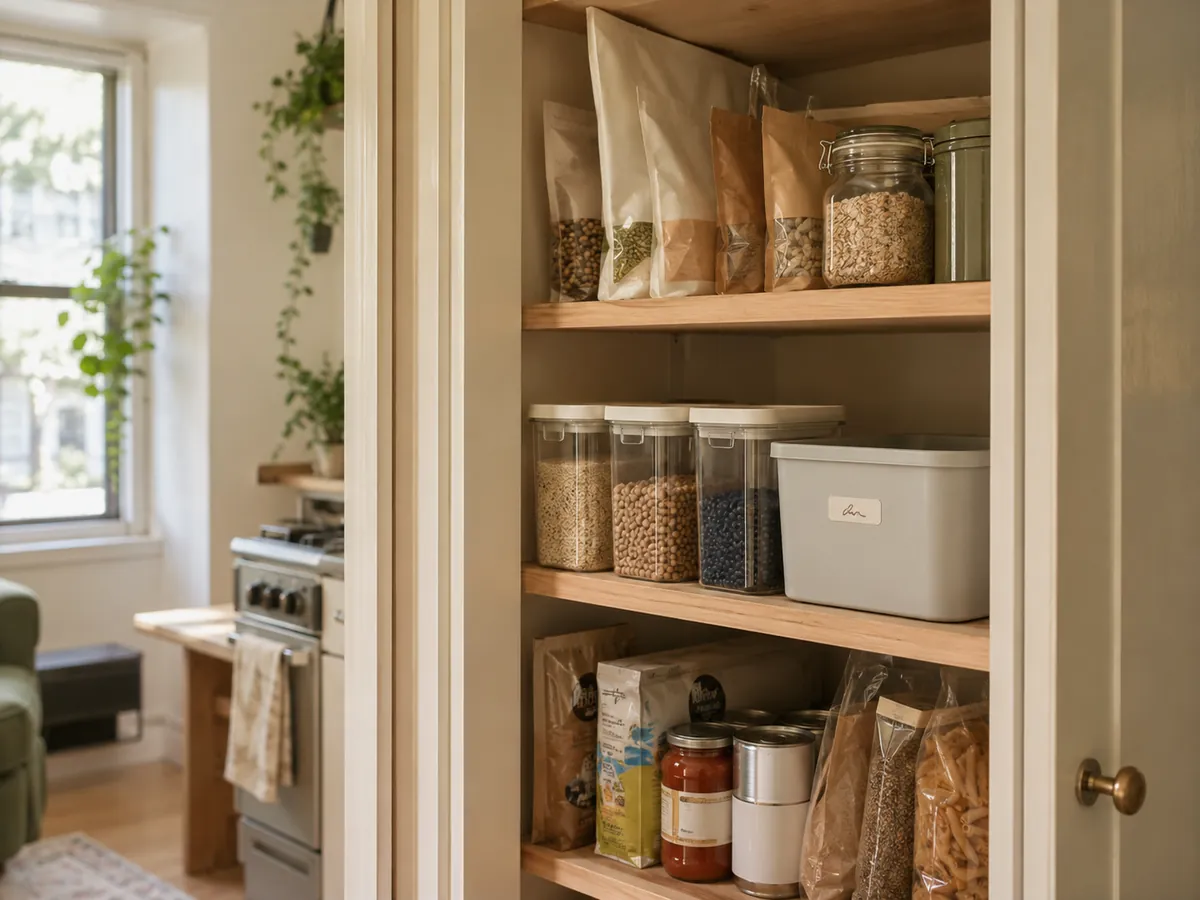
In a small kitchen, a food can become separated from the information that helps you identify it. A shared shelf, a loose container, a crowded cabinet, or a well-meant transfer can leave the product name, ingredients, allergen information, dates, lot code, directions, or manufacturer contact somewhere else.
This guide is about preserving useful information, not creating a prettier pantry. Leaving food in its original package is valid and is often the simplest choice. Transferring food is optional, and no label can replace the full original package record.
Why useful package information disappears in small kitchens
Information can be lost when a package is discarded, a label faces the wall, a shared shelf separates a lid from its container, or food is moved before anyone decides what details the household may need later. Not every package contains every kind of information, and a handwritten note cannot recreate information you did not preserve.
Decide whether transferring is necessary
- Keep food in its original package when it fits safely and the package remains intact.
- If visibility is the problem, try moving the original package, changing its position, or grouping it with similar items before transferring anything.
- Treat a secondary container as optional. Check the product label, package integrity, child access, storage directions, and the container manufacturer's instructions first.
- Do not transfer food when the original package carries handling, allergen, preparation, recall, or safety information you cannot preserve accurately.
What information may be worth keeping visible
| Information | Why it may matter | Boundary |
|---|---|---|
| Product identity | Helps distinguish one food from another in a shared space. | A generic handwritten name may be incomplete. |
| Ingredients | Supports household questions about what is in the food. | Do not reconstruct an ingredient list from memory. |
| Allergen information | Keeps the package's declared information available for review. | Do not diagnose allergy safety from a secondary label. |
| Date information | Keeps the manufacturer's date visible for context. | A date alone does not determine safety. |
| Lot or batch information | May help identify a product in an official recall notice. | Keep the original package or record only what you can verify. |
| Directions and storage | Keeps product-specific handling available. | The package and manufacturer instructions control. |
| Manufacturer contact | Provides a route for product questions. | Do not substitute a retailer summary for the manufacturer. |
What a secondary label cannot replace
A secondary label can identify a food for a household, but it cannot guarantee that the ingredients, allergen statement, date context, lot code, directions, or manufacturer contact are complete. If someone in the household depends on exact ingredient or allergen information, keep the original package or use the manufacturer's current information rather than relying on memory.
When the original package should stay
- The package is intact and fits safely where it is.
- The food needs directions, warnings, preparation information, or storage conditions that a short label would not capture.
- A child-resistant feature, seal, temperature instruction, or package-specific handling matters.
- The food is shared, allergy-relevant, recalled, or difficult to identify after transfer.
- The receiving container's material, seal, cleanliness, or care instructions are unknown.
Dates, allergens, infant formula, and recalls
FDA explains that, except for infant formula, federal law generally does not require quality-based date labels on packaged food and that date phrases are not uniform. A quality date is not, by itself, a complete safety decision. Use current product, package, and agency guidance for the food in front of you.
Read the FDA date-label and food-safety guidance for the distinction between quality dates and safety questions.
FDA allergen guidance says ingredients can change and recommends checking the label each time when an allergy matters. Do not infer allergen safety from a remembered recipe, a handwritten label, or a secondary container.
See FDA's guidance to read food-allergy labels for the current label boundary.
Recall information may use product names, package sizes, UPCs, lot codes, dates, and distribution details. Retain enough identifying information to consult an official notice; this article is not a recall-monitoring service.
Use the FDA food-recall guidance when a recall question arises.
A no-purchase information check
- Choose one shelf, bin, or shared-storage area.
- Ask whether each food needs to leave its original package at all.
- If something has moved, identify which original information is still available and what is missing.
- Keep the original package when a short label would be incomplete or when package-specific handling matters.
- Stop, ask the manufacturer, or consult an official source when the household cannot identify the food or its relevant instructions.
Sources and limits
This article supports information preservation, not food-safety diagnosis, allergy advice, recall monitoring, container selection, shelf-life extension, waste reduction, savings, or universal packaging decisions. Product labels, manufacturer instructions, current FDA notices, FoodKeeper where applicable, and the needs of the household remain controlling.
Read ETLH's editorial and corrections policy if a source or passage needs review.
Found something we should correct?
Send the article title, the passage in question, and any supporting source through our contact page. Material corrections will be made transparently.