Electric Food-Waste Appliances for Apartments: What to Check
Use a neutral evaluation framework for countertop food-waste appliances: what they do, what they leave for you to handle, and when not to buy one.
Published by Eco Tiny Living Hub
Reviewed under our editorial and corrections policy.
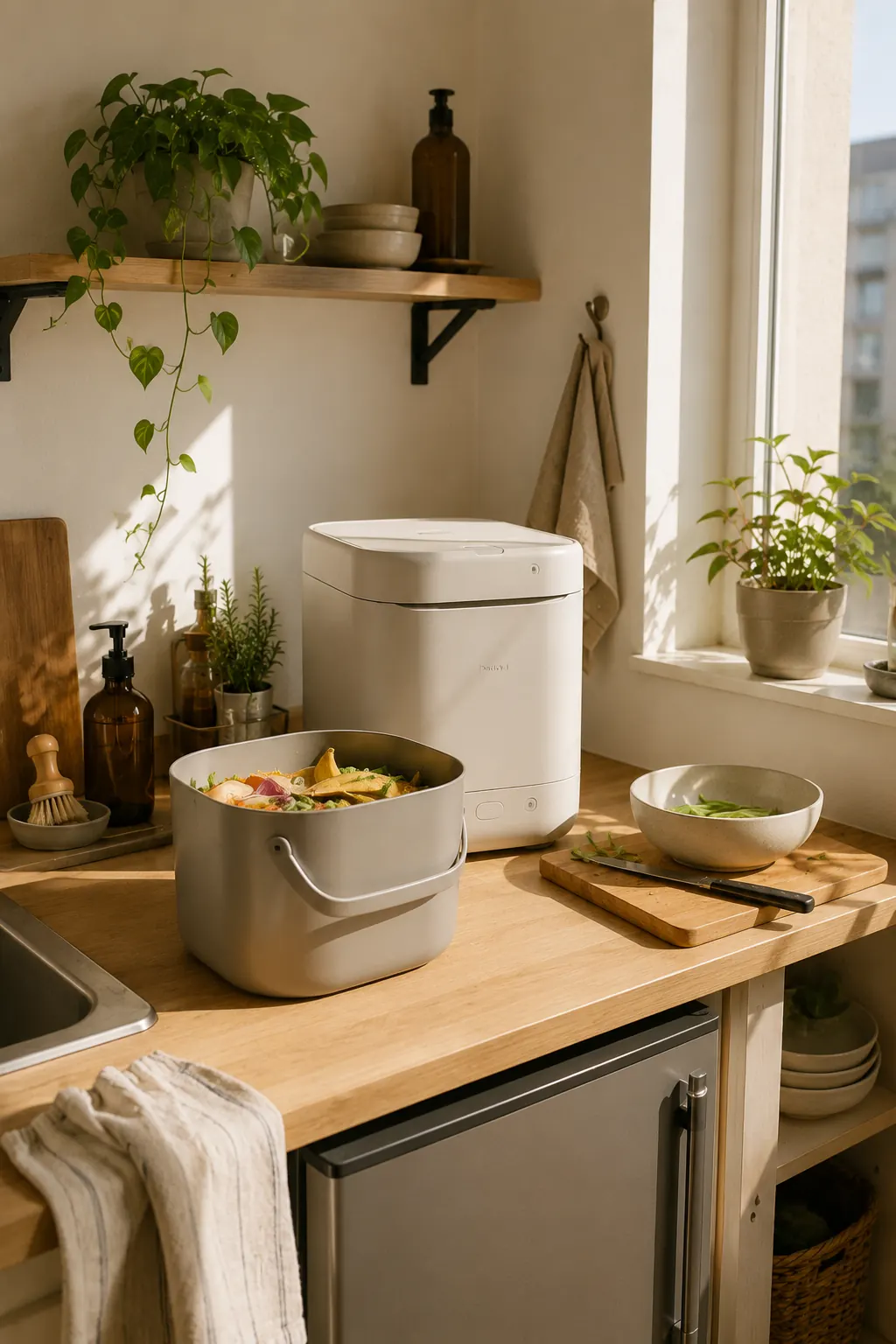
A countertop food-waste appliance can be a treatment step in a food-scrap system. It is not automatically a composting system, a collection service, or a solution to an unavailable handoff route. Before comparing models, identify what the appliance does to food scraps and what you will do with the output.
This is an evaluation framework, not a product roundup. Do not buy is a valid conclusion when the output route, counter space, electricity, noise, cleaning, building rules, or recurring maintenance does not fit.
Name the process before calling the output compost
An appliance may heat, grind, dry, mix, or otherwise reduce the volume and weight of food scraps. Those are different actions from managed aerobic biological decomposition. EPA says residential grinders and dehydrators create a dried food-scrap mixture, not compost, and that the material is not biologically stable without further treatment.
Read EPA's approaches to composting for the distinction between pre-processing and composting.
| Question | Why it matters |
|---|---|
| Does the manual describe drying, grinding, heating, mixing, biological processing, or more than one step? | The description tells you what the appliance is designed to do; it does not establish that the output is finished compost. |
| What material may go in, and what is excluded? | Accepted inputs vary by model and must come from the actual manual, not another appliance, a retailer, or a collection program. |
| What comes out, and where is that output permitted to go? | Plan this before purchase. A local collection program or soil use may have its own rules, and may not accept appliance output. |
| What is the cycle, cleaning, and filter or consumable routine? | A claimed convenience benefit does not replace the routine described by the manufacturer. |
Plan the output route before the counter space
Write down the output route in one sentence. For example: “I will keep the treated material only until the named program confirms it accepts it,” or “I do not currently have an approved route, so I will not buy.” Do not put treated material into a garden, municipal cart, drain, or trash stream based on a general appliance claim; check the destination's current instructions.
EPA's home-composting guidance states that these appliances reduce volume and weight but do not produce compost; a composting system or collection program is a separate step.
Check apartment fit without promising convenience
- Counter and storage: Measure the appliance, clearance, outlet reach, lid movement, ventilation requirements in the manual, and the space needed for output, filters, cleaning, and a backup container.
- Electricity and building rules: Use only the voltage, outlet, cord, placement, and ventilation instructions for the exact model. Check lease and building rules before adding an appliance to a shared or restricted space.
- Noise and timing: Review the manual's noise or cycle guidance, then decide whether the cycle timing is compatible with sleep, work, neighbors, children, pets, and shared-household needs. Do not assume quiet operation.
- Capacity and interruption: Check the actual capacity, cycle length, cooling or reset instructions, and what happens if you have more scraps than the appliance can take.
- Cleaning and consumables: Identify washable parts, cleaning frequency, filters, additives, replacement parts, availability, and disposal instructions. Treat those as ongoing tasks, not minor footnotes.
- Warranty and support: Read the exact warranty, return, geographic coverage, proof-of-purchase, and excluded-use terms before relying on a stated coverage period.
Read the actual model documents
Manufacturer material is the appropriate source for product-specific operation, but it is not independent proof of an outcome. For example, Lomi's current FAQ points buyers to model user manuals and gives model-specific filter, cleaning, and troubleshooting information; it notes that cycles can make cracking, grinding, or creaking sounds. Its warranty terms describe a one-year limited warranty for specified products and conditions. These details are examples of document categories to review, not an endorsement of that brand or a prediction of every appliance's behavior.
Use the manufacturer's FAQ and model-manual links to find model-specific operating information, then read the applicable warranty terms rather than relying on a retailer summary.
Lomi's published warranty terms illustrate why geographic coverage, proof of purchase, current exclusions, and accessory terms belong in the comparison—not just a headline warranty duration.
When not to buy
- You cannot name an approved or workable output route.
- The appliance would block a needed counter, sink, food-storage, outlet, walking, or accessibility area.
- The required electrical, ventilation, cleaning, noise, capacity, or building-rule conditions do not fit the apartment.
- You do not want the filter, consumable, cleaning, or output-handling routine described in the current documents.
- A verified collection or drop-off route already solves the food-scrap handoff without adding an appliance.
If you have not yet mapped a full route, return to How to Choose an Apartment Food-Scrap Method before comparing an appliance.
Sources and limits
EPA sources support the category-level composting boundary. Manufacturer sources support only the specific documentation they publish and can change. This guide does not rank products, estimate electricity use, promise odor or pest control, claim a saving, assert an environmental comparison, or say that an appliance fits every renter. Local program rules, building rules, and manufacturer instructions remain controlling.
Read ETLH's editorial and corrections policy if a source or passage needs review.
Found something we should correct?
Send the article title, the passage in question, and any supporting source through our contact page. Material corrections will be made transparently.